
We’ve all been there: standing in the middle of a room, staring at bare white walls, clutching a single throw pillow, and wondering, “Where on earth do I start?” Decorating a home is a bit like cooking a complex meal. If you just throw random ingredients into a pot, you might end up with something edible, but it won’t be a masterpiece. To create a space that feels cohesive, intentional, and uniquely “you,” you need a recipe. This home decor guide is that recipe.
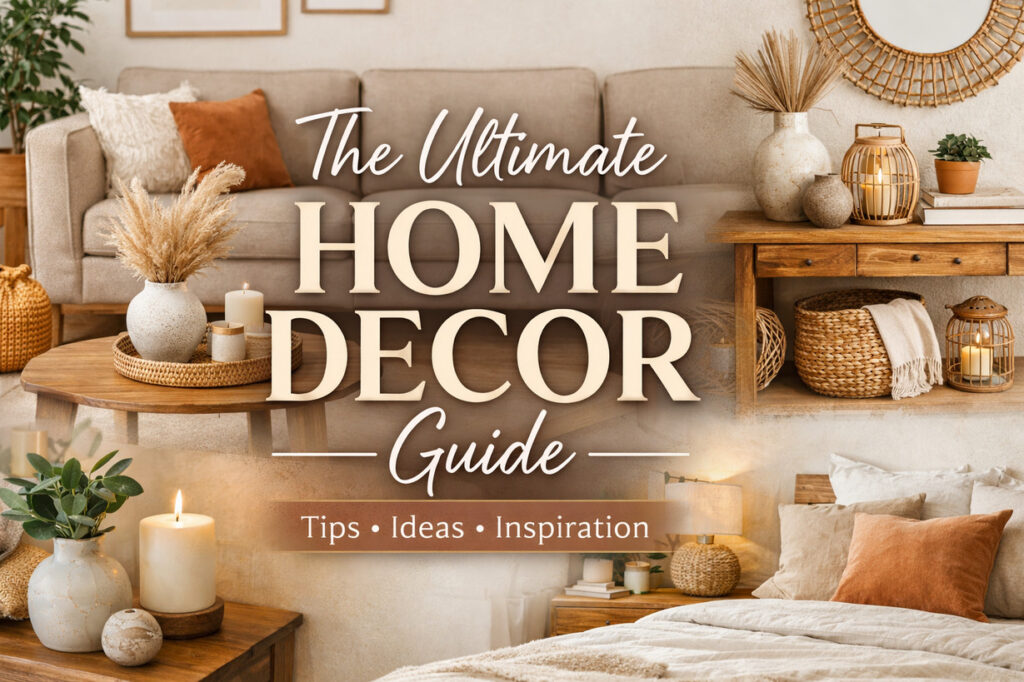
Whether you are moving into your first apartment, renovating a fixer-upper, or simply tired of looking at a living room that feels “unfinished,” this guide will walk you through the foundational principles of interior design.
Table of Contents
Phase 1: Finding Your Signature Style
Before you spend a single cent, you need a vision. The biggest mistake beginners make is buying individual items they like without considering how they fit into the “big picture.”
Define Your Aesthetic
You don’t need a degree in architecture to identify what you like. Start by looking at your wardrobe or your favorite travel destinations. Do you like clean, crisp lines, or are you drawn to cozy, cluttered bookshelves and soft textures?
Common design styles include:
- Minimalist: Focuses on “less is more.” Think neutral colors, hidden storage, and high-quality materials.
- Bohemian (Boho): A “more is more” approach. Expect lots of plants, layered rugs, rattan furniture, and global patterns.
- Industrial: Inspired by old factories. It features exposed brick, blackened steel, and raw wood.
- Scandi (Scandinavian): Focuses on hygge (coziness). Light woods, functional furniture, and plenty of natural light.
The Power of the Mood Board
The best way to solidify your style is to create a digital mood board. Use platforms like Pinterest or Canva to gather images of rooms that make you feel something. After saving 20–30 images, look for the common threads.
Ready to apply these styles to a specific room? Check out my guide to budget friendly bathroom makeovers.
Observation Tip: Do most of your saved images have blue walls? Dark wood? Gold hardware? These are your subconscious preferences coming to the surface.
Phase 2: Mastering Color Theory and Palettes
Color is the most powerful (and often the cheapest) tool in your home decor guide arsenal. It dictates the mood of the room.
The 60-30-10 Rule
To achieve professional-level balance, follow this classic interior design formula:
- 60% Primary Color: This is usually your neutral base. It covers the walls, large rugs, and perhaps your largest sofa.
- 30% Secondary Color: This provides contrast. Use it for chairs, curtains, or an accent wall.
- 10% Accent Color: This is your “pop.” Use it for pillows, artwork, vases, and small decor items.
Understanding Temperature
- Warm Colors: Reds, oranges, and yellows. These create energy and “closeness.” They are great for social spaces like dining rooms.
- Cool Colors: Blues, greens, and purples. These promote relaxation and focus. They are perfect for bedrooms and home offices.
Phase 3: Layout, Scale, and Proportion
A beautiful chair can look like a mistake if it’s the wrong size for the room. This is where “Scale and Proportion” come into play.
Measure Twice, Buy Once
Before buying furniture, use painter’s tape to “draw” the outlines of the furniture on your floor. This helps you visualize how much walking space you’ll have left.
- The Golden Rule: Leave at least 30 to 36 inches for walkways to avoid a cramped feeling.
- Rug Size Matters: A common beginner mistake is buying a rug that is too small. In a living room, all the front legs of your furniture should, at a minimum, sit on the rug. If the rug is floating in the middle of the room like a postage stamp, it makes the room look smaller.
The Focal Point
Every room needs a “star.” This could be a fireplace, a large window with a view, or a bold piece of art. Arrange your furniture to compliment this focal point rather than competing with it.
Phase 4: The Three Layers of Lighting
If your only light source is a single “boob light” on the ceiling, your home will feel like a sterile office. Great decor requires layered lighting.
| Light Type | Purpose | Example |
| Ambient | General illumination | Ceiling fixtures, recessed lighting |
| Task | Focused light for activities | Reading lamps, under-cabinet kitchen lights |
| Accent | Creating drama and depth | Picture lights, LED strips behind a TV, candles |
Pro Tip: Always choose bulbs with a “Warm White” rating (around 2700K to 3000K). It mimics sunset and makes skin tones and furniture look much more inviting.
Phase 5: Adding Character with Accessories
This is where the magic happens. Accessories are the “jewelry” of the room.
Texture is Everything
If a room feels “flat” even though the colors are right, you’re likely missing texture. Mix different materials to create visual “weight”:
- Smooth (glass, metal)
- Rough (jute rugs, raw wood)
- Soft (velvet, wool, faux fur)
The Rule of Three
When styling a coffee table or a shelf, group items in odd numbers. A trio of objects (for example: a tall vase, a medium-sized candle, and a small stack of books) feels more natural and balanced to the human eye than a pair of objects.
Bringing the Outdoors In
No home decor guide is complete without mentioning plants. Not only do they purify the air, but the organic shapes of leaves break up the harsh straight lines of furniture and walls. If you’re a “black thumb,” start with a Snake Plant or a Pothos—they are nearly impossible to kill.
Phase 6: Common Pitfalls to Avoid
Even with the best intentions, it’s easy to slip up. Here are three things to watch out for:
- The “Set” Trap: Avoid buying the entire furniture set (matching sofa, loveseat, and chair). It lacks personality and makes your home look like a showroom. Mix and match pieces for a curated feel.
- Hanging Art Too High: Art should be at eye level. For most people, the center of the piece should be about 57 to 60 inches from the floor.
- Ignoring the Entryway: The entry is the first impression. Even a small hook and a mirror can make a huge difference in how you feel when you walk through the door.
Glossary of Home Decor Terms
Keep these in your back pocket so you can talk like a pro at the hardware store.
- Ambient Lighting: The primary “base” layer of light in a room (usually your overhead light).
- Centerset Faucet: A faucet where the handles and spout are all connected on a single base (usually for sinks with holes 4 inches apart).
- Color Drenching: A design technique where you paint the walls, trim, and ceiling the exact same color to create a seamless, high-end look.
- Grout Pen: A specialized marker used to “re-color” or whiten existing grout lines without replacing the tile.
- LVT (Luxury Vinyl Tile): A durable, waterproof flooring that snaps together or peels-and-sticks; perfect for DIYers.
- Rule of Three: A design principle suggesting that objects arranged in odd numbers are more appealing, memorable, and effective than even-numbered groupings.
- Vignette: A small, intentional arrangement of decor items (like on a countertop or shelf) that tells a “story.”
- Widespread Faucet: A faucet where the spout and handles are separate pieces (usually for sinks with holes 8 inches apart).
The Home Decor “Final Walkthrough” Checklist:
- [ ] The “Eye-Level” Check: Are your frames hung at the correct height (57–60 inches)?
- [ ] The “Rule of Three”: Are your shelf and table groupings in odd numbers?
- [ ] The Cord Concealment: Are messy lamp or TV cords hidden from view?
- [ ] The Texture Mix: Does the room have at least three different textures (wood, fabric, metal)?
- [ ] The Lighting Mood: Turn off the “big light.” Does the room feel cozy with just lamps and accent lights?
Vibe check: Complete. Shop the look and explore our full range of aesthetic room decor ideas for every square foot of your home.
Summary: Your Home is an Evolution
The most important takeaway from this home decor guide is that your home should never be “finished.” As you travel, grow, and change, your space should reflect that. Don’t rush to fill every corner in a single weekend. The best homes are those that are collected over time, filled with pieces that have a story.


Pingback: Budget Friendly Bathroom Makeovers: 7 Easy DIY Ideas Under $500
Pingback: Guide to Boho Home Decor: Create a Space That Tells a Story
Pingback: Guide To Living Room Decor Ideas: Transform Your Home’s Heart
Pingback: Industrial Home Decor: How To Achieve The Modern Urban Look
Pingback: 10 Stunning Low-Maintenance Houseplants To Brighten Your Home
Pingback: Kitchen Island Decor Ideas: 25 Stylish Ways To Elevate Your Kitchen
Pingback: Minimalist Home Decor: The Complete Guide To A Calm Home